
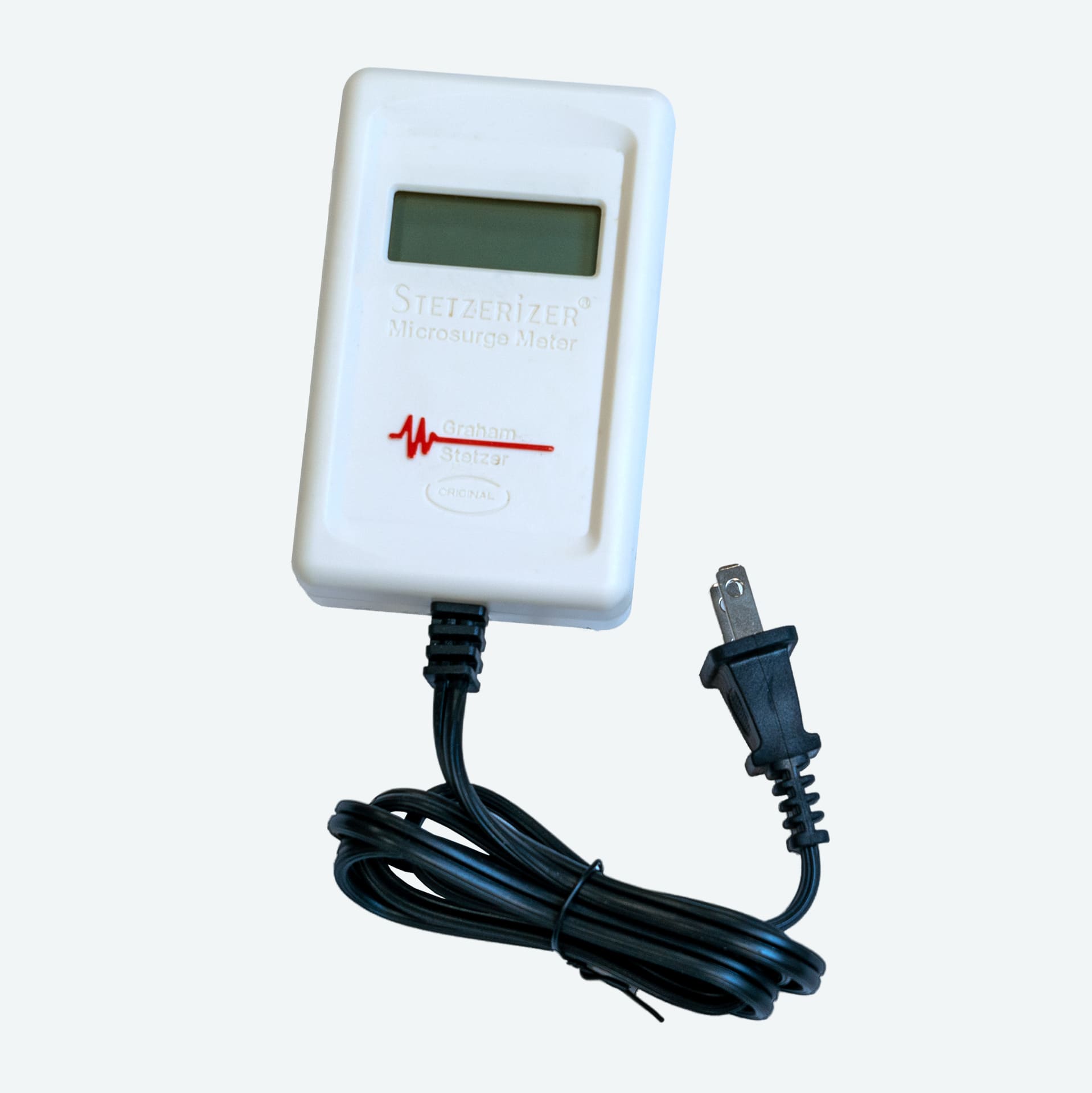
Stetzerizer Microsurge Meter
$150.00
Description
The STETZERiZER® Microsurge Meter by Graham-Stetzer is designed to separate the power line frequency, allowing it to detect and respond to low-level high-frequency voltages caused by transients and harmonics on power lines. The level of these voltages is measured in GS (Graham-Stetzer) units and will vary with electrical equipment and loads. This device is recommended for use in conjunction with original STETZERiZER® Filters. The STETZERiZER® Microsurge Meter was specifically designed as a companion to the STETZERiZER® Filters. The meter measures the amount of high-frequency energy present, and its primary use is to guide effective STETZERiZER® Filter installation. United States Patent #6,914,435. All Rights Reserved.
More Information
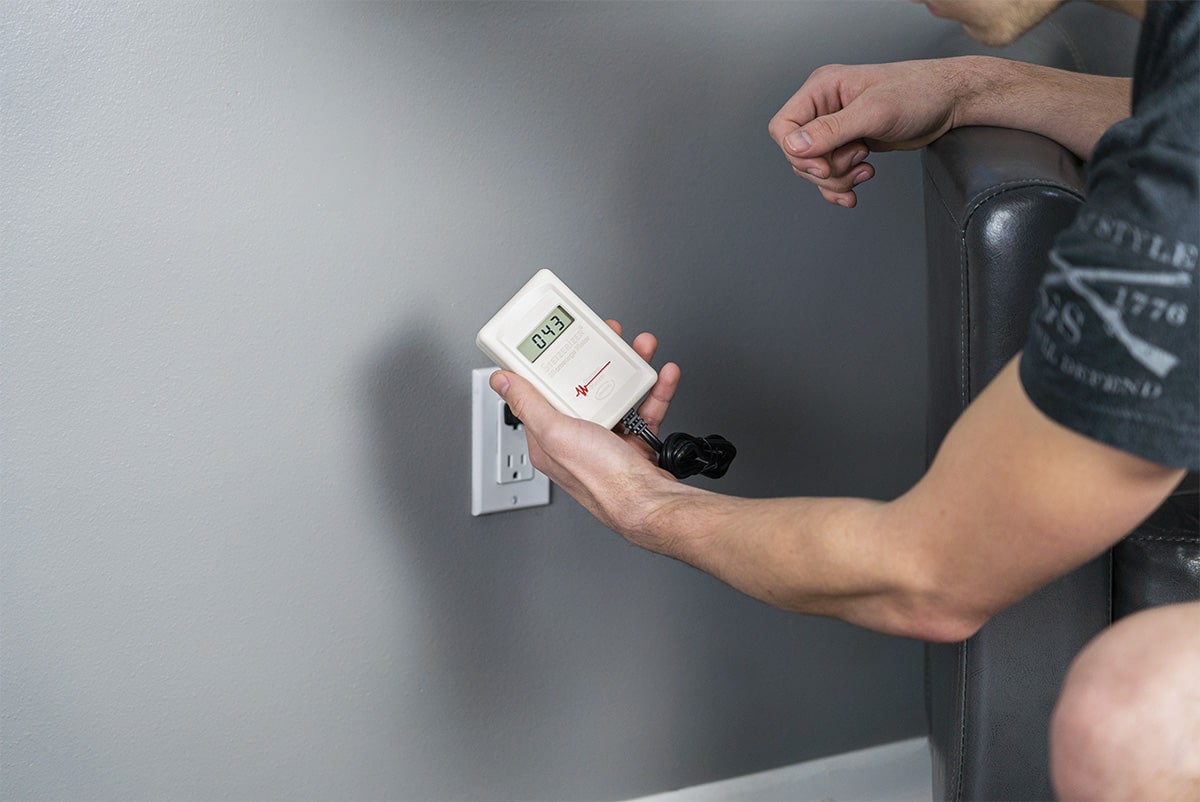
The STETZERiZER® Microsurge Meter is easy to use — simply plug the meter into any standard electrical outlet and view the reading on the screen. Readings are displayed in GS (Graham-Stetzer) Units — a simple numerical value assigned to a complex calculation of the instantaneous amount of high-frequency energy (dirty electricity) present at an electrical outlet.
The STETZERiZER® Microsurge Meter operates on 120V or 240V electrical systems, with frequencies of 50 or 60 Hz. An appropriate plug adapter is required where Type A/B (NEMA 1-15/NEMA 5-15) plugs are not available.
The LCD reads in GS (Graham-Stetzer) Units – more precisely, dV/dt – which is an approximation for the high-frequency energy. High frequencies are the frequencies that are most harmful to equipment, animals, and humans.
The STETZERiZER® Microsurge Meter is certified by the Government of Kazakhstan as the official means of measuring RF Energy on building wires. Good, marginal, and undesirable range of meter readings are conveniently listed on the back of the Microsurge Meter.
Electrosensitive people have reported sensitivities with readings as low as 27 on the Microsurge meter. However, medium or even low Microsurge Meter readings should not be interpreted as a guarantee that there is no harmful health impact; only a medical expert can determine that. Caution is required. Some harmful health effects of high-frequency energy on humans appear to be cumulative and possibly irreversible. Science is inconclusive in this area, although the body of empirical evidence available for guidance continues to expand and stabilize.
Technical Information
The STETZERiZER® Microsurge Meter measures the average magnitude of the voltage surge (i.e., the rate of change of the voltage with time) at the electrical socket. One GS Unit is 24 Volts per second. A human with a low impedance to one of the outlet’s terminals (the grounded wire) and a capacitive coupling of 800 picofarads to wiring connected to the other terminal (the hot wire) would have a current flowing through them, as indicated by the STETZERiZER® Microsurge Meter. The capacitance of two parallel metal plates, each 1 meter by 1 meter and separated by 1 centimeter, is approximately 800 picofarads. The capacitance of a human to the hot wires will usually be less than 800 picofarads, and the current through the human will be proportionately lower. The current flow through the human will also depend on how the capacitance of the human to the wire is distributed over the human. This is important since it is the current flowing inside the body, and where it is flowing internally, that determines the effect it will have on the human. The frequency band covered by the STETZERiZER® Microsurge Meter starts at approximately 180 Hertz (Hz). It extends well into the kilohertz (kHz) range, evaluating all the most common frequencies found in modern electrical wiring systems. For complete specifications on the STETZERiZER® Microsurge Meter, see U.S. Patent #6,914,435.
Microsurge Meter Design Criteria
Microsurge Meters were specifically designed as a companion to the STETZERiZER® Filters. The meters measure the level of harmful electromagnetic “energy” present, and their primary use is to guide effective filter installation.
The Stetzerizer Microsurge Meter is a low-cost, robust, and user-friendly device suitable for non-technical individuals. The meter was designed to measure low-level high-frequency transients and harmonics present on electrical wiring in buildings, which are the frequencies most detrimental to human health. The meters effectively ignore the effects of 60 Hz power and other lower, less harmful frequencies. Specifically, the meter measures the average magnitude of the changing voltage as a function of time (dV/dt), which naturally emphasizes transients and other high-frequency phenomena that change rapidly with time. The measurements of dV/dt read by the meter are defined as GS (Graham-Stetzer) units (since no standard term is available). The GS units are a measure of “harmful energy,” which is a function of frequency, or more generally, rate of change of voltage or dV/dt.
Using the Microsurge Meter for a Typical Home Installation
Microsurge meters measure the levels of safe, borderline, or dangerous levels of “energy” present. These levels are conveniently shown on the back of the meter for reference. These levels have been developed through research (much of it in Russia and neighboring countries) and confirmed by experience in North America and other countries worldwide. The levels have been adopted by the Sanitary Stations (Health Departments) of the Republic of Kazakhstan.
Starting from points that typically have the highest readings, such as where computers and televisions are plugged in, the meter is used to measure both the initial levels of GS energy and its reduction as filters are added. Once the GS levels are acceptably reduced (by at least 20%) at one location, the process should be repeated at the next location. After the installation of the filters is complete, a final confirmation of the GS levels should be performed throughout the house.
Information

Product Specifications
| Weight | 0.5 lbs |
|---|---|
| Dimensions | 7.75 × 6 × 1.125 in |
| Color | White |
| Input | 120-240V, 50/60 Hz |
| Cord Length | 36 inches |
| For Use In | All Countries |
| Plug Type | NEMA 1-15 (Type A, ungrounded, non-polarized) |